

Treatment chair repairs
We repair treatment chairs used in registered renal units, with attention to safe positioning, electrical function and patient comfort. Our technicians handle fault finding, parts replacement, adjustment and records so the chair can return to service with a clear repair trail.
What is included in treatment chair repairs
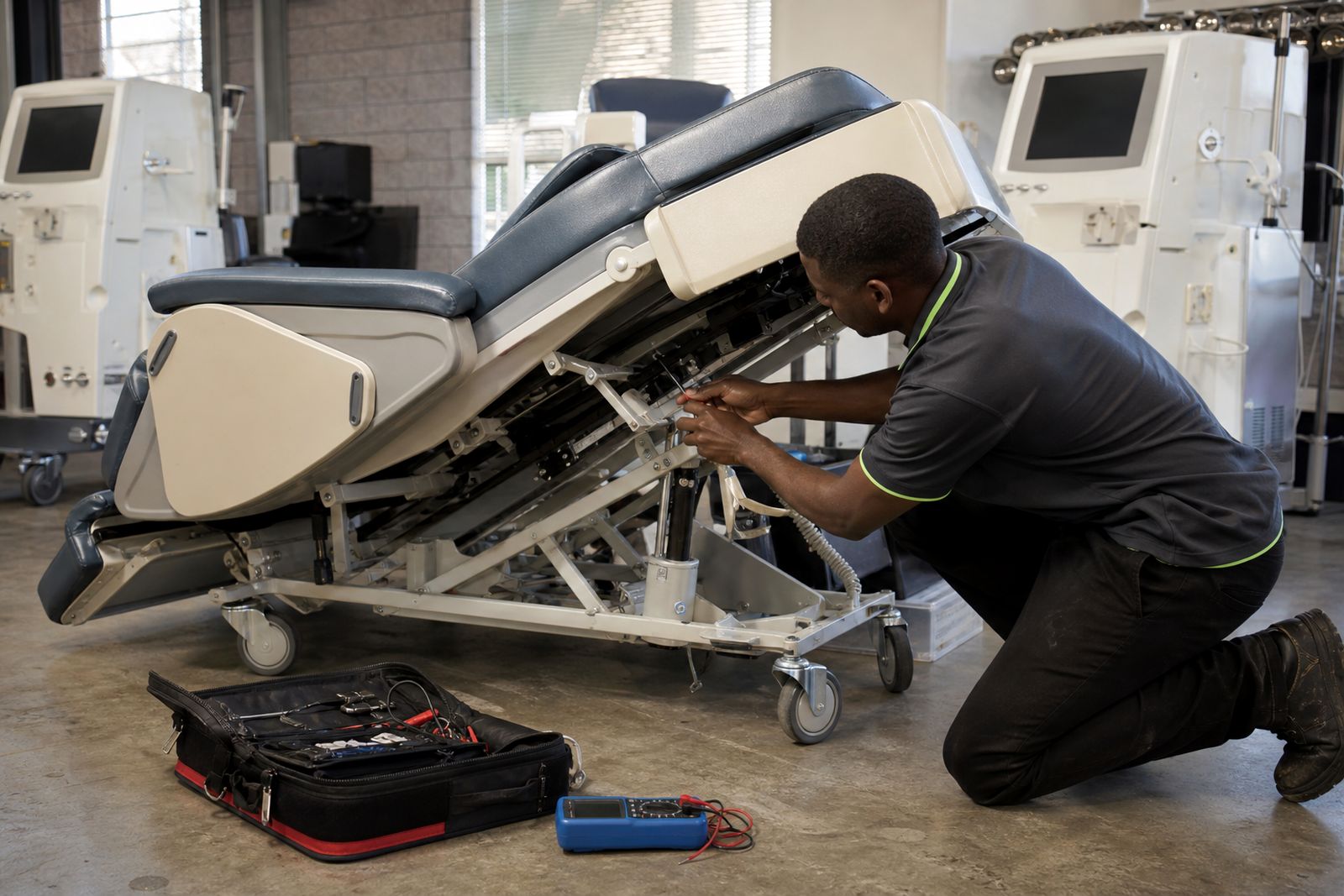
Treatment chairs in dialysis units work hard every day, and the faults are usually mechanical, electrical or wear-related rather than cosmetic only. We repair chair systems that affect safe use during treatment, including backrest recline, leg-rest movement, height adjustment, castors, brakes, hand controls, actuator operation, power supplies and damaged upholstery sections where practical.
Our work is limited to the technical condition of the chair. We do not advise on clinical positioning, patient suitability or nursing practice, as those decisions remain with the renal unit. We work only for registered facilities and not for home users.
- Lift and recline faults
- Actuator and handset checks
- Power lead, plug and connection repairs
- Brake, wheel and frame checks
- Armrest, side support and fastener replacement where needed
- Upholstery assessment, panel repair or replacement where feasible
Typical faults we see in renal units
Most chair call-outs relate to movement that has become slow, uneven or completely inoperative. A chair may stop lifting under load, fail to recline fully, drift out of position, trip its power protection or show intermittent response from the control. In busy units, castors and braking parts also wear from frequent movement between stations.
We also see split seams, cracked covering and fluid ingress around switches or hand controls. Coastal humidity can affect connectors and exposed metal parts, while repeated cleaning can harden coverings and strain some plastics over time. If a chair has been moved during generator changeover or power cut recovery there can also be power-supply faults that look like a control problem at first.
- No power to the chair
- Chair moves in one direction only
- Backrest or leg section jams
- Uneven lifting or tilting
- Brake not holding properly
- Torn or contaminated upholstery
Our repair process step by step
We start by confirming the reported fault and the chair location in the unit, then the technician checks the chair identity and service history if available. A visual inspection is followed by function testing, basic electrical checks and mechanical assessment. Where safe and appropriate, the chair is tested through its full range of movement to isolate whether the fault sits with the control, actuator, power supply, linkage or frame.
If the repair can be completed on site, we carry out the work, re-test the chair and note the parts used. If workshop attention is needed, we advise the unit and arrange removal if required. For chairs linked to a treatment bay plan, units should identify which station is affected so disruption can be managed properly.
After repair, the chair is checked again for stable movement, stop positions, visible cable routing, braking and general safety. Teh technician then records the work completed and any follow-up items the unit should monitor.
- Fault confirmation with unit staff
- Inspection of controls, wiring and moving parts
- Mechanical and electrical testing
- Repair on site or removal for workshop repair
- Functional re-test after repair
- Service record for unit files and audits
What your unit should prepare before the visit
A prepared chair saves time and helps the technician work safely. Please make sure the chair can be identified clearly and that staff can describe the fault as accurately as possible, including whether it occurs under patient load, only in one position or only at certain times of day. If the unit has noticed tripped plugs, unusual noises or fluid exposure, that information is useful.
Where possible, clear the space around the chair and make sure a nearby power point is accessible. If the chair has been taken out of service, tag it so staff do not return it to use before testing is complete. If there are infection-control handling requirements for the area, advise us through the enquiry form before the visit.
- Unit asset or chair ID
- Description of the fault and when it started
- Whether the chair is safe to move
- Access to the treatment bay or storage area
- Any decontamination steps required by the facility
- Previous repair notes if available
How repair charges are worked out
Repair charges depend on what is found during fault finding and whether the work is completed on site or in the workshop. In general terms, the cost is shaped by technician time, travel where applicable, the type of fault, replacement parts needed, and whether additional checks are required after a major movement or electrical repair.
Upholstery work is usually assessed by the condition and extent of the damaged section rather than by surface appearance alone, because stitching, fastening points and underlying support matter. Mechanical jobs may need bushings, pins, gas struts, actuators, switchgear or power components, and the availability of suitable parts can affect the scope of work. If more than one fault is present we will note that, so the unit can decide how to proceed.
We do not publish standard chair repair prices on this page. Units can send the chair details and fault description through the contact page for review.
Aftercare, records and return to service
Once the chair has been repaired, the unit should place it back into service only after local checks are complete and the responsible team is satisfied with the result. We recommend a brief observation period during normal use, especially after lift or recline repairs, to confirm smooth operation and that no fasteners work loose. If staff notice unusual sounds, drifting or intermittent control again the chair should be withdrawn and reported.
Our service record helps the facility keep track of recurring faults, replaced parts and audit requirements. For units managing several chairs, these records are useful when planning preventive maintenance and deciding whether repeat failures point to age, cleaning exposure, electrical supply issues or heavy usage patterns.
Chairs should be kept clean and dry around controls, with cables routed away from wheel paths and sharp frame edges. Small issues picked up early are usually easier to sort out before the chair becomes unusable which can affect station planning in a busy session.
What our Dialysis Machine Servicing customers say
Verified Google reviews
Questions we get asked
Can you repair a chair on site in the unit?
Yes, many faults can be assessed and repaired on site if access is suitable and the work can be completed safely. If workshop repair is the better option, we will advise the unit accordingly.
Do you replace torn upholstery?
We assess upholstery damage case by case. Where practical, damaged sections can be repaired or replaced, but the decision depends on hygiene condition, attachment method and the overall state of the chair.
Do you work on chairs for home dialysis patients?
No. We work only for registered renal units and other registered facilities, and we do not provide support for home-user equipment.
Also worth a look
Book a service or report a fault
Send a note through our contact form with your unit, the equipment involved and what you need, and a technician will contact you.
Open the contact form